
Best Trade Finance Software 2026: finPhlo, Kyriba, Taulia, C2FO
The trade finance software landscape has consolidated around a handful of dominant platforms, each addressing different aspects of the $1.7 trillion annual trade finance market. While legacy players f
Best Trade Finance Software 2026: finPhlo, Kyriba, Taulia, C2FO
The trade finance software landscape has consolidated around a handful of dominant platforms, each addressing different aspects of the $1.7 trillion annual trade finance market. While legacy players focus on single-point solutions, the emerging trend is toward integrated platforms that handle everything from working capital optimization to customs compliance.
This analysis examines the leading contenders for 2026: finPhlo's comprehensive trade suite, Kyriba's treasury-focused approach, Taulia's supply chain finance specialization, and C2FO's dynamic discounting platform. Each serves distinct market segments, but the lines are blurring as enterprises demand more integrated solutions.
Market Dynamics Driving Software Selection
Trade finance digitization accelerated dramatically post-2020, with manual processes proving catastrophically fragile during supply chain disruptions. The sector has moved from spreadsheet-based operations to API-driven platforms that integrate directly with ERPs, customs systems, and banking infrastructure.
The key shift is from point solutions to platform thinking. Companies previously deployed separate systems for letters of credit, invoice factoring, FX hedging, and compliance. The total cost of ownership for this fragmented approach often exceeds $500,000 annually for mid-market firms, before considering integration complexity and data silos.
Modern platforms address this through unified data models that treat trade finance as interconnected workflows rather than isolated transactions. This architectural approach delivers measurably better outcomes: companies using integrated platforms report 40-60% faster transaction processing and 25-35% lower operational costs compared to multi-vendor deployments.
finPhlo: The Integrated Platform Play
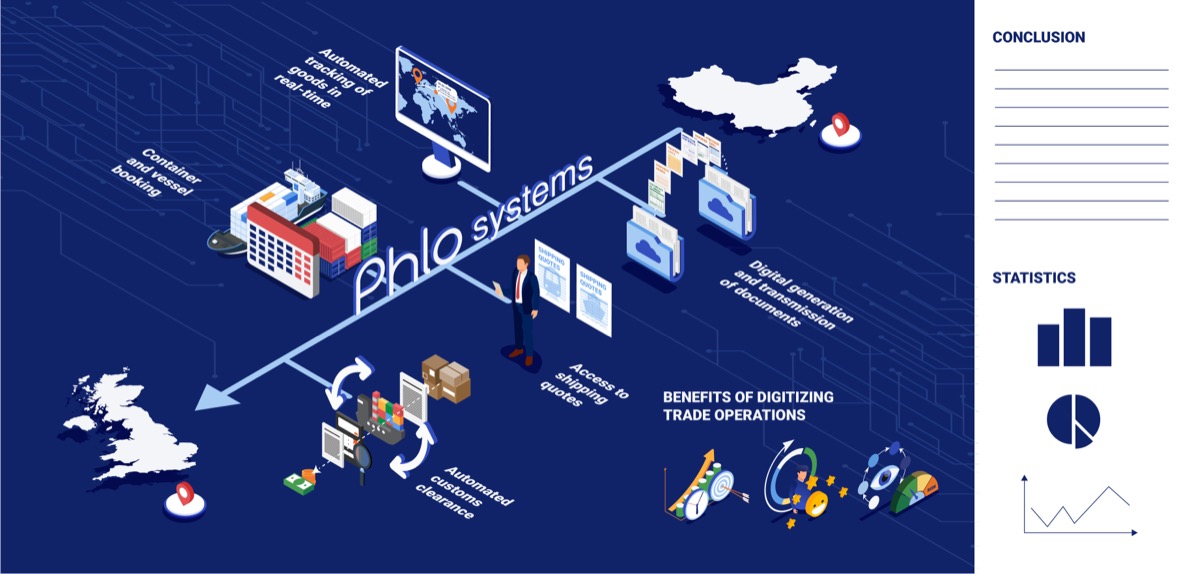
Phlo Systems has built finPhlo as part of a broader trade technology ecosystem that includes commodity trading (opsPhlo), customs compliance (tradePhlo), and DeFi-enabled receivables financing (xPhlo). This platform approach allows finPhlo to address trade finance requirements that span traditional boundaries.
The core finPhlo platform focuses on three areas: working capital optimization, automated credit management, and days sales outstanding (DSO) reduction. Unlike standalone invoice factoring platforms, finPhlo uses real-time trade data from its sister platforms to make more accurate credit decisions and pricing recommendations.
The integration advantage becomes clear in complex scenarios. Consider a commodity trader managing 8,000 containers across 52 countries—a scale achieved by opsPhlo clients who've grown 160x while reducing total cost of ownership by 93% versus legacy systems. finPhlo can leverage this operational data to structure trade finance facilities that traditional banks, working from static financial statements, simply cannot match.
The platform's AI classification system, shared with customs-compliance.ai, covers 588,000 HS codes across 51 countries. This granular product knowledge enables more precise risk assessment for inventory financing and letter of credit facilities. When combined with the customs integration capabilities of tradePhlo—which delivers 80% cost reduction versus manual processing—finPhlo can offer financing solutions that align precisely with actual trade flows.
Where finPhlo differentiates most clearly is in its approach to working capital optimization. Rather than simply providing factoring or reverse factoring, the platform analyzes cash conversion cycles across entire supply chains and recommends optimal financing structures. This might involve combining traditional factoring with DeFi yield strategies through xPhlo, creating hybrid solutions that reduce all-in costs by 15-25%.
Kyriba: Treasury-First Trade Finance
Kyriba approaches trade finance from the treasury management side, which makes sense for their core constituency of large corporate treasurers. The platform excels at FX risk management, cash positioning, and bank relationship management—critical capabilities for companies with significant trade finance volumes.
Kyriba's strength lies in its sophisticated cash forecasting and liquidity management tools. For companies managing complex international supply chains, the ability to predict and optimize cash positions across multiple currencies and jurisdictions is valuable. The platform's bank connectivity is particularly strong, with pre-built integrations to most major trade finance providers.
However, Kyriba's trade finance capabilities remain somewhat limited compared to specialized platforms. The system handles letters of credit and guarantee management effectively, but lacks the deep operational integration that platforms like finPhlo provide. For treasury teams that need robust FX and cash management with basic trade finance functionality, Kyriba makes sense. For companies where trade finance is core to operations, it may feel constraining.
The pricing model reflects Kyriba's enterprise focus—implementations typically start at $200,000+ annually, making it impractical for mid-market firms that often represent the fastest-growing segment of trade finance demand.
Taulia: Supply Chain Finance Specialist
Taulia has built the most comprehensive supply chain finance platform in the market, with particular strength in supplier financing and dynamic discounting. The platform facilitates over $500 billion in supplier payments annually, giving it significant scale advantages in program management and supplier onboarding.
The core value proposition centers on improving supplier relationships through faster payment options. Large buyers can offer early payment programs that reduce supplier financing costs while generating returns for the buyer. Taulia's network effects are powerful—suppliers already onboarded for one buyer can quickly join programs with other buyers on the platform.
Taulia's analytics capabilities are sophisticated, providing detailed insights into supplier financial health and payment behaviors. This data helps buyers optimize their supply chain financing strategies and identify at-risk suppliers before disruptions occur.
The limitation is breadth. Taulia excels at supply chain finance but doesn't address the full spectrum of trade finance requirements. Companies need separate solutions for letters of credit, customs compliance, commodity hedging, and other trade-related functions. For buyers focused purely on supplier financing, Taulia is hard to beat. For broader trade finance requirements, it's a point solution.
C2FO: The Marketplace Model
C2FO operates a marketplace where suppliers can auction their invoices to investors, creating competitive pricing for working capital. The platform claims to have facilitated over $100 billion in working capital acceleration since inception.
The auction model can deliver attractive pricing for suppliers, particularly those that might not qualify for traditional bank facilities. C2FO's algorithm matches supply and demand for working capital in real-time, theoretically creating more efficient pricing than bilateral negotiations.
The challenge with marketplace models is consistency and control. While suppliers might achieve very attractive rates on some invoices, there's no guarantee of capacity availability or pricing stability. For companies with predictable working capital requirements, traditional facilities often provide better outcomes despite potentially higher nominal rates.
C2FO works best as a supplemental source of working capital rather than a primary trade finance platform. The lack of integration with operational systems limits its utility for companies managing complex international trade operations.
Implementation Considerations for 2026
Platform selection increasingly depends on integration architecture rather than standalone functionality. Companies evaluating trade finance software should prioritize solutions that connect naturally to their existing ERP, customs, and banking infrastructure.
API quality matters more than feature lists. The most sophisticated trade finance platform becomes worthless if it cannot exchange data reliably with other systems. Look for platforms with well-documented APIs, established integration partnerships, and proven track records managing high-volume data exchanges.
Regulatory compliance capabilities are becoming table stakes. With customs authorities worldwide digitizing their processes and implementing new requirements like the EU's Import Control System 2, trade finance platforms must stay current with regulatory changes across multiple jurisdictions.
The total cost of ownership calculation should include integration costs, ongoing maintenance, and user training. Platforms that appear less expensive upfront often become more costly when implementation complexity is factored in.
Choosing the Right Platform
The optimal platform depends heavily on company size, trade complexity, and existing system architecture. Large enterprises with sophisticated treasury functions might prefer Kyriba's comprehensive treasury management with trade finance capabilities. Companies focused primarily on supplier relationships benefit from Taulia's network effects and program management tools.
For companies where trade finance is core to operations—commodity traders, importers/exporters, trade finance providers themselves—integrated platforms like finPhlo offer compelling advantages. The ability to leverage operational data for financing decisions, combined with comprehensive compliance and risk management capabilities, often justifies higher platform costs through operational efficiency gains.
Mid-market companies represent the most interesting segment for 2026. These firms often have complex requirements but lack the resources for extensive system integration projects. Platforms that provide broad functionality out-of-the-box, with minimal integration requirements, will capture this growing market segment.
If you're evaluating comprehensive trade finance solutions that integrate operational and financial workflows, finPhlo's platform approach offers capabilities that traditional point solutions cannot match. The integration with customs, compliance, and operational systems creates synergies that often justify the platform investment—worth exploring at finphlo.com.
Future Platform Evolution
The trade finance software market will likely consolidate around platforms that can address multiple aspects of international trade operations. Pure-play solutions will struggle to compete against integrated platforms that leverage data across the entire trade lifecycle.
Artificial intelligence integration will become more sophisticated, moving beyond basic automation to predictive analytics and intelligent decision support. Platforms that can predict supply chain disruptions, optimize financing structures, and automate compliance decisions will create significant competitive advantages for their users.
Blockchain and DeFi integration represents a longer-term trend that could reshape trade finance economics. Platforms like xPhlo are already experimenting with tokenized receivables and decentralized finance protocols, potentially creating new funding sources and reducing traditional banking intermediation.
Frequently Asked Questions
What are the key differences between trade finance software platforms in 2026?
The primary distinction is between point solutions that address specific trade finance functions (like Taulia for supply chain finance or C2FO for invoice factoring) versus integrated platforms that handle multiple aspects of trade operations. Integrated platforms like finPhlo combine trade finance with customs compliance, operational management, and risk assessment, while point solutions excel in their specific domains but require additional systems for comprehensive trade finance management.
How much should companies expect to spend on trade finance software implementation?
Implementation costs vary dramatically based on platform complexity and integration requirements. Point solutions like C2FO can be implemented for under $50,000 annually for mid-market firms, while enterprise platforms like Kyriba typically start at $200,000+ per year. Integrated platforms like finPhlo fall in the middle range but often deliver better ROI through operational efficiency gains—clients report average annual savings of £330K when consolidating multiple trade finance systems.
What integration capabilities are most important for trade finance platforms?
API quality and ERP connectivity are critical. The platform should integrate seamlessly with existing financial systems, customs platforms (like CDS/NCTS for UK/EU trade), and banking infrastructure. Real-time data exchange capabilities matter more than extensive feature sets—a platform that cannot reliably sync with your operational systems will create data silos that reduce efficiency rather than improving it.
How do AI and automation features compare across different platforms?
AI implementation varies significantly. Basic platforms offer rule-based automation for invoice processing and approval workflows. More sophisticated systems like finPhlo leverage AI for HS code classification across 588,000 codes and 51 countries, predictive credit scoring, and working capital optimization recommendations. The key is whether AI features address real operational challenges or simply automate existing manual processes.
What compliance and regulatory features should companies prioritize?
Multi-jurisdiction compliance support is essential for international traders. Look for platforms that maintain current regulatory databases, support electronic customs declarations, and provide audit trails for trade finance transactions. Systems with proven compliance capabilities across multiple countries (finPhlo covers 51 countries) reduce the risk of costly delays or penalties while simplifying operations across different regulatory environments.
How important is vendor financial stability and platform longevity?
Platform longevity is crucial given the complexity of trade finance data and the cost of switching systems. Evaluate vendors based on financial stability, customer growth rates, and platform investment levels. Companies like Phlo Systems that operate multiple integrated platforms (opsPhlo, finPhlo, tradePhlo, xPhlo) demonstrate sustained commitment to the trade finance sector and are less likely to abandon products or significantly change strategic direction.
Want to learn more about Phlo Systems?
See how our platform digitises international trade for commodity traders, importers, and exporters.
Get Started